1701 - Magnetic Declination Chart
Updated: Jul 7, 2025

Edmund Halley, the famous astronomer whom we already acknowledged in previous chronicles, now aged 45, publishes the General Chart of the Variation of the Compass.
This chart is based on his observations that he made aboard the Paramour – a weird name for a science-purpose warship. Halley was given command of this 90-ton 6-gun pink in 1698-1700 for the purpose of a hydrographic exploration of the Atlantic ocean to determine the variation of Magnetic North against True North. He required the addition of an extra year of navigation for a survey of tides and tidal currents in the English Channel this year. Science profited from this short period of peace. War has broken out once more.
The chart displays isogonic lines of identical magnetic declination for any place in the Atlantic ocean, South as North. Once again, Halley’s initiative is extremely pertinent. Moreover, as usual, Halley’s rendition is a model of clarity and of practicality. This is a major improvement for a better navigation.

Halley’s work replaces scattered values, possibly outdated, metered and registered here and there. It also substitutes for the rules of thumb established by pioneers as Jean Rotz (†1560), who, in 1542 in the treaty he presented to King Henry VIII, put forward a magnetic variation of one degree every 22½ leagues of three miles, whatever the latitude. It was based on very few data. It was supposed to increase west when sailing to west and east when sailing to east.
As for the trade winds, Halley cumulated data through a survey of reliable captain’s knowledge to make up his mind prior to his mission. He already knew that declination varies with time – a few degrees by century.
He sailed up to the Shetland islands by 60° of latitude North and up to 52° of latitude South. To figure out what it covers, Cape Horn lies by 56° South and Cape of Good Hope by 34°20' South.
From data which are obviously discrete, he has established curves by interpolation and extrapolation. He has clearly assumed continuity of derivatives in the wide area of his survey as they display continuity in Europe.
By the way, his work also settles old issues :
(1) there have still been a few retarded sailors to deny or ignore the declination between magnetic North and geographical North, although Christopher Columbus already noticed it two centuries ago ;
(2) on the opposite, there have been a few candid others, after Colombus himself, who expected to determine longitude from an observation of declination against the Polaris star, but, unfortunately, declination does not display a linear variation with longitude : an isogonic line of declination is no meridian ;
(3) and, in the middle, the ones who believe in a simplistic calculation after Rotz.

It is worth saying a word of dead reckoning navigation.
As the helmsman cannot read or write in general, he used a traverse board to record the time spent by sailing along a specific rhumb. Time was given by a half-an-hour hourglass. The helmsman pegs every half-hour run along the rhumb.
The pilot noted down the distance run along a rhumb and the spreed given by the log. Then he could reset the traverse board.
__________
IN RETROSPECT FROM TODAY
NOTE - On the construction of isogonic lines.
Halley did not make his method explicit. It is worth noticing that Halley was a mathematician of first rank. In 1694 he produced his own algorithm of numerical analysis to find roots of a nonlinear function by iterations. It is a development of Newton’s method and it converges faster.
__________
SUGGESTED BIBLIOGRAPHY
Eva Germaine Rimington Taylor - The Haven-Finding Art, A History of Navigation from Odysseus to captain Cook - London, 1956
__________
CREDIT
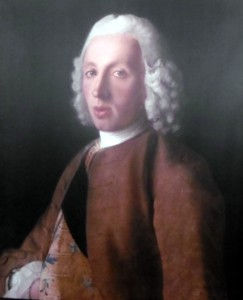
Thomas Murray - portrait of Edmund Halley - oil on canvas, 1690 - © National Portrait Gallery


Comments