top of page
Scientific Revolution in Maritime Sphere
(Naval Architecture, Shipbuilding, Navigation, Hydrography...)


1840 - Creation of the Steam Mail Packet Service
Samuel Cunard Last year, Samuel Cunard, 53 years old, was awarded the Mail Packet Service between Liverpool and Halifax, as he promised the British Admiralty to ensure a mail transport every fortnight all year long, what neither the Great Western Steamship Company nor the British and American Steam Navigation Company dared to propose. He has accordingly established the British and North American Royal Mail Steam Packet Company in Glasgow with his associates, famous George Bu
Luc CHAMBON
May 163 min read


Naviguer dans l’Inconnu - Sailing Uncharted Waters
Une idée a traversé la sagesse grecque pendant des siècles. Elle vient d’un des Sept Sages fondateurs de la philosophie, Anacharsis semble-t-il. Elle fait des gens qui sont en mer une catégorie entre les vivants et les morts, livrée au hasard du vent et des vagues. Appareiller, c’est jouer sa vie et disparaître du monde dès que le bateau passe l’horizon. Plus encore que les marins antiques, ceux de l’ère des découvertes ont vécu cet exil. Ils ont accompli de longs périple
Luc CHAMBON
Apr 1822 min read


1761 - Birth of Oceanography
Grønland (1756) The Danish 50-gun Grønland, launched five years ago at Nyholm island near Copenhagen, departs for a scientific expedition in the Mediterranean sea. She got used to navigating these dangerous waters for she protected Danish trade ships against Barbary pirates lately. This expedition is named the Arabia mission. It has been mounted under the auspices of King Frederick V, who has wisely achieved not to get involved in the global war which begun five years ago.
Luc CHAMBON
Sep 11, 20252 min read


1767 - Trial of Pierre Le Roy's Chronometer
Aurore After having tackled the building of a marine watch in 1756, Pierre Le Roy, 50 years old, has reached a new step last year. It is said that the chronometer he presented to the Académie Royale des Sciences is as precise and reliable as famous Harrison's H4 made in 1759. ¤ Le Roy already invented the detent pivot escapement, or detached escapement, that he presented the Académie in 1748, the temperature-compensated balance by using bi-metallic components, and lately th
Luc CHAMBON
Jul 10, 20252 min read


1772 - Two Time Metering Methods for James Cook
James Cook James Cook, the famous explorer, 44 years old by now, departs for his second voyage around the world with a copy of famous Watchmaker John Harrison’s H4, that is the watch K1, and three other time-keepers made last year. ¤ Harrison's H4 was the prototype which achieved to meet the accuracy requirement set by the Board of Longitude when crossing the Atlantic ocean. It completed it twice, in 1761 and 1763 - results met with some initial scepticism by the Board of L
Luc CHAMBON
Jun 27, 20254 min read


1843 - Sumner’s Method of Celestial Navigation
Sumner's Manual Captain Thomas Hubbard Sumner publishes a New and Accurate Method of Finding a Ship’s Position at Sea . This is the fruit...
Luc CHAMBON
Apr 22, 20252 min read


1837 - A Fortunate Incident of Navigation
Captain Thomas Hubbard Sumner, 30 years old, commanding the sailing ship Cabot, travelling from Charleston, Virginia, to Greenock, Scotland, makes a practical discovery. Smalls Lighthouse where Sumner landed Due to constant bad weather all along his journey, he has navigated on a dead reckoning basis until he finally encounters a piece of blue sky which gives him sight of the sun. He uses the altitude of the sun to make a calculation of longitude based on his estimated latit
Luc CHAMBON
Apr 22, 20252 min read


1736 - A Prototype Marine Chronometer
Harrison's Chronometer H1 John Harrison, 46 years old, trials his first marine chronometer H1, built last year, on a round trip between London and Lisbon. A total failure on the way outward - it lost time -, the way back brings an encouraging success in the form of a precise landing against a 60-mile error in longitude for the traditional method of navigation by dead reckoning and by position shift through sun observation. This unexpected half-success rouses the Board of Lon
Luc CHAMBON
Apr 21, 20252 min read


1731 - Appearance of the Octant
John Hadley John Hadley, a mathematician aged 49, presents a new instrument of navigation, the octant, also known as the reflecting quadrant, at the Royal Society. A member of the Royal Society, he is already and rightly famous as the inventor of the parabolic reflecting telescope which he presented ten years ago. Three other person at least are working on an instrument of the same sort these days : (1) Thomas Godfrey, 27, a glazier, likely ahead of the group by one or two y
Luc CHAMBON
Apr 21, 20254 min read


1701 - Magnetic Declination Chart
Edmund Halley Edmund Halley, the famous astronomer whom we already acknowledged in previous chronicles, now aged 45, publishes the General Chart of the Variation of the Compass. This chart is based on his observations that he made aboard the Paramour – a weird name for a science-purpose warship. Halley was given command of this 90-ton 6-gun pink in 1698-1700 for the purpose of a hydrographic exploration of the Atlantic ocean to determine the variation of Magnetic North agains
Luc CHAMBON
Apr 21, 20253 min read


1679 - Pierre Arnoul Ousted
Pierre Arnoul A distinguished naval administrator, Pierre Arnoul, aged 28, is held responsible for a shipwreck so ousted from his...
Luc CHAMBON
Apr 21, 20253 min read


1679 - First Issue of Connoissance des Temps
Joachim d’Alencé, an astronomer, publishes the first release of an annual ephemeris, the ‘ Connoissance des Temps' . He has worked on...
Luc CHAMBON
Apr 21, 20253 min read


1752 - Accurate Lunar Tables
Tobias Mayer Tobias Mayer, a German astronomer aged 29, publishes Tabulæ motuum Solis et Lunæ novæ et correctæ, that are tables of the...
Luc CHAMBON
Apr 20, 20254 min read


1838 - Crossing the Atlantic Ocean under Steam
SS Sirius Two steamships - SS in short -, Sirius and Great Western, simultaneously cross the Atlantic Ocean from Cork in Ireland for the first, from Bristol in England for the second, to New York, in 18½ and 15½ days respectively, the second departing 4 days after the first and arriving the day after, that is on the 23rd of April while Sirius arrived on the 22nd. Sirius has transported 45 passengers, Great Western only seven. ¤ Great Eastern caught fire in her machinery dur
Luc CHAMBON
Apr 20, 20256 min read


1818 - First Regular Transatlantic Packet Line
Line Ticket The Wright, Thompson, Marshall & Thompson Line, founded last year, has opened the first regular service between New York and...
Luc CHAMBON
Apr 20, 20254 min read


1714 - The Longitude Act
Isaac Newton The Longitude Act is passed by the Parliament ‘ for providing a Publick Reward for such Person or Persons as shall...
Luc CHAMBON
Apr 20, 20255 min read

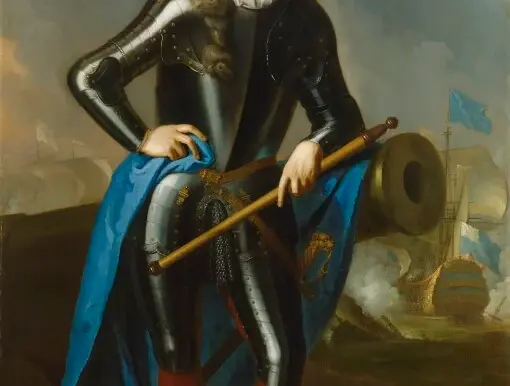
1707 - Fleet Shipwreck
On the 22nd of October, three ships of the line, the 90-gun Association , the 70-gun Eagle , and the 50-gun Romney run aground on the Western reefs of Scilly islands. They founder with all hands but one. The fireship Firebrand also goes ashore and sinks with half her crew. The 90-gun St George and the fireship Phoenix strike on the reefs too but manage to get off. On her own, the 100-gun Royal Anne escapes the rocks within a hair. A thousand and three hundreds sail
Luc CHAMBON
Apr 20, 20254 min read


1678 - Fleet Wrecking
On the 11th of May, thirteen French warships run aground on the reefs of an isolated small archipelago in the West Indies. This is the final act of the Franco-Dutch war which has seen, after the series of setbacks suffered in the North sea in 1672-74, a number of naval victories of the French against the Dutch in the Mediterranean sea, then in Africa at Gorée island, and then in the Caribbean sea. The campaign in the West Indies has been successful so far and Admiral Jean II
Luc CHAMBON
Apr 19, 20257 min read
bottom of page