top of page
Scientific Revolution in Maritime Sphere
(Naval Architecture, Shipbuilding, Navigation, Hydrography...)


1691 - Bell & Compass
Edmund Halley, an astronomer and polymath aged 35, already famed for quite a few achievements in astronomy and meteorology, presents two inventions at the Royal Society : (1) a diving bell ; (2) a damped compass. Diving Bell Halley's Diving Bell & Diving Suit Halley has been thinking about a diving bell meant to working underwater for a while. Two years ago, he produced a paper describing a bell moving on its four wheels on sea bottom, fitted with an air intake so as to main
Luc CHAMBON
Jun 11, 20255 min read


1731 - Appearance of the Octant
John Hadley John Hadley, a mathematician aged 49, presents a new instrument of navigation, the octant, also known as the reflecting quadrant, at the Royal Society. A member of the Royal Society, he is already and rightly famous as the inventor of the parabolic reflecting telescope which he presented ten years ago. Three other person at least are working on an instrument of the same sort these days : (1) Thomas Godfrey, 27, a glazier, likely ahead of the group by one or two y
Luc CHAMBON
Apr 21, 20254 min read


1701 - Magnetic Declination Chart
Edmund Halley Edmund Halley, the famous astronomer whom we already acknowledged in previous chronicles, now aged 45, publishes the General Chart of the Variation of the Compass. This chart is based on his observations that he made aboard the Paramour – a weird name for a science-purpose warship. Halley was given command of this 90-ton 6-gun pink in 1698-1700 for the purpose of a hydrographic exploration of the Atlantic ocean to determine the variation of Magnetic North agains
Luc CHAMBON
Apr 21, 20253 min read

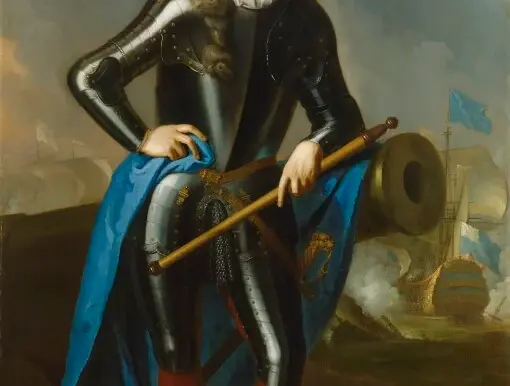
1707 - Fleet Shipwreck
On the 22nd of October, three ships of the line, the 90-gun Association , the 70-gun Eagle , and the 50-gun Romney run aground on the Western reefs of Scilly islands. They founder with all hands but one. The fireship Firebrand also goes ashore and sinks with half her crew. The 90-gun St George and the fireship Phoenix strike on the reefs too but manage to get off. On her own, the 100-gun Royal Anne escapes the rocks within a hair. A thousand and three hundreds sail
Luc CHAMBON
Apr 20, 20254 min read


1686 - Trade Winds
Edmund Halley Edmund Halley, an astronomer and polymath aged 30, presents at the Royal Society a map of the Trade Winds also known as Easterlies. As for the Atlantic ocean, they have been known by the Portuguese since the beginning of the exploration, that is in the first half of the 15th century. As for the Pacific ocean, this is Andrés de Urdaneta (†1568) who brought them to light in 1565 and plotted a map for the Manila galleon route between the Philippines and Acapulco.
Luc CHAMBON
Apr 19, 20254 min read
bottom of page